

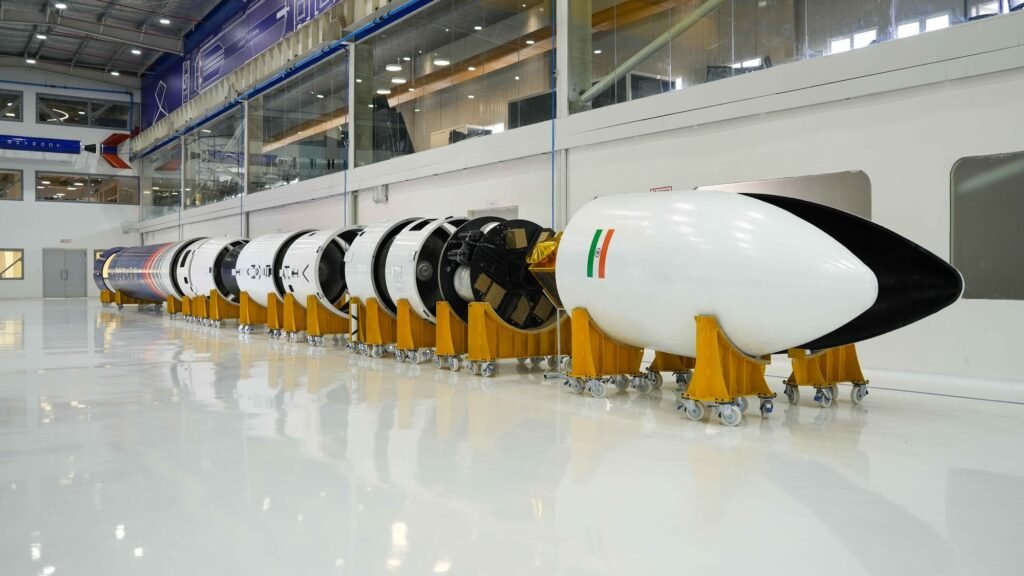
For decades, India’s achievements in space have been closely associated with ISRO. From launching satellites to exploring the Moon and Mars, the country’s space ambitions were driven almost entirely by its national space agency. That story changed with the successful launch of Vikram-1, developed by Skyroot Aerospace, India’s first privately built orbital launch vehicle.
The mission is more than just another rocket launch. It represents the arrival of India’s private space industry as a serious player in global space transportation and demonstrates that Indian startups are now capable of building advanced launch systems once considered the exclusive domain of governments.
A New Era for Indian Space Startups
Founded in 2018 by former ISRO engineers, Skyroot Aerospace was created with a clear goal: make satellite launches faster, more affordable, and more accessible. As the number of small satellites being launched worldwide continues to grow, the company aims to provide dedicated launch services instead of forcing customers to wait for rideshare opportunities.
The successful flight of Vikram-1 validates years of engineering, testing, and investment. It also shows how India’s space reforms have encouraged private companies to participate in an industry that was once dominated by government organisations.
What Makes Vikram-1 Special?
Vikram-1 is a four-stage launch vehicle designed primarily for placing small satellites into Low Earth Orbit (LEO). Unlike heavy-lift rockets built for large scientific missions, Vikram-1 focuses on commercial customers who need reliable access to space for lightweight payloads.
The rocket incorporates modern manufacturing techniques and is designed with cost efficiency in mind. Its payload capacity of around 300–350 kilograms makes it suitable for Earth observation satellites, communication satellites, technology demonstrations, and research missions.
The vehicle is named after Dr. Vikram Sarabhai, the visionary scientist widely regarded as the father of India’s space program.
Mission Aagaman: A Historic First Flight
Skyroot named its inaugural orbital mission Aagaman, meaning “arrival.” The name reflects the company’s entry into the league of organizations capable of launching satellites into orbit.
During the mission, Vikram-1 successfully deployed multiple payloads into Low Earth Orbit, proving that the rocket’s propulsion system, guidance software, stage separation, and satellite deployment mechanisms performed as intended.
For a first orbital attempt, achieving mission objectives is a remarkable engineering accomplishment. Many launch companies around the world have required multiple attempts before reaching orbit.
Why This Launch Matters
The significance of Vikram-1 extends far beyond one successful mission.
India’s First Private Orbital Rocket
Until now, orbital launches from India were carried out exclusively by ISRO. Vikram-1 demonstrates that Indian private companies can independently design, manufacture, test, and launch orbital-class rockets.
This milestone marks a major shift in India’s space ecosystem.
Expanding Commercial Opportunities
The demand for launching small satellites has increased rapidly over the past decade. Governments, universities, research organisations, and private companies all require reliable launch services.
By offering dedicated launches, Skyroot could help meet this growing demand while reducing dependence on international launch providers.
Boosting Innovation
Successful missions encourage investment in the wider space ecosystem. Companies working on propulsion systems, satellite technology, space electronics, advanced materials, and software all benefit when launch opportunities become more frequent.
A thriving private launch industry creates opportunities not only for rocket manufacturers but for hundreds of supporting businesses.
Strengthening India’s Global Position
The commercial space launch market is highly competitive, with companies from the United States, Europe, China, and New Zealand already serving customers worldwide.
Skyroot’s success gives India another opportunity to establish itself as an attractive destination for affordable and reliable satellite launches.
Skyroot and ISRO: Competitors or Partners?
It is easy to assume that private companies will replace government space agencies, but that is unlikely.
ISRO continues to focus on national missions, planetary exploration, scientific research, defence-related projects, and large-scale space infrastructure. Private companies such as Skyroot serve a different market by providing commercial launch services.
The relationship is similar to NASA and SpaceX in the United States. Government agencies focus on strategic objectives, while private companies expand commercial capabilities and drive innovation.
Rather than competing directly, both sectors strengthen the country’s overall space ecosystem.
Challenges Ahead
Although Vikram-1 has achieved an important milestone, long-term success depends on consistency.
Launching rockets is one of the most demanding engineering challenges in the world. Skyroot must now demonstrate that it can deliver reliable launches repeatedly while maintaining safety standards and competitive pricing.
The company also faces competition from established international launch providers that already have proven flight records and long-term commercial customers.
Winning global confidence will require many more successful missions.
What This Means for India’s Future
India’s space economy is expected to grow significantly during the coming decade. Satellite communication, navigation, Earth observation, agriculture, disaster management, climate monitoring, and defence all rely increasingly on access to space.
Private launch providers like Skyroot can help support this growth by increasing launch capacity, encouraging technological innovation, and attracting domestic as well as international investment.
The success of Vikram-1 also sends a powerful message to Indian entrepreneurs: world-class space technology can be designed, developed, and launched from India.
Final Thoughts
The successful launch of Vikram-1 is more than a victory for one startup—it represents a turning point for India’s private space industry. By reaching orbit, Skyroot Aerospace has demonstrated that Indian private companies are capable of tackling some of the world’s most complex engineering challenges.
While one successful mission does not guarantee long-term dominance, it establishes a strong foundation for future growth. If Skyroot continues to build on this achievement, Vikram-1 may one day be remembered as the mission that opened a new chapter in India’s journey into space.
Source:
www.SkyrootAerospace.in